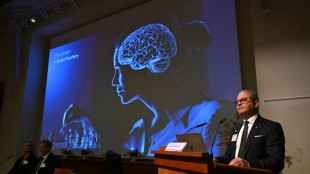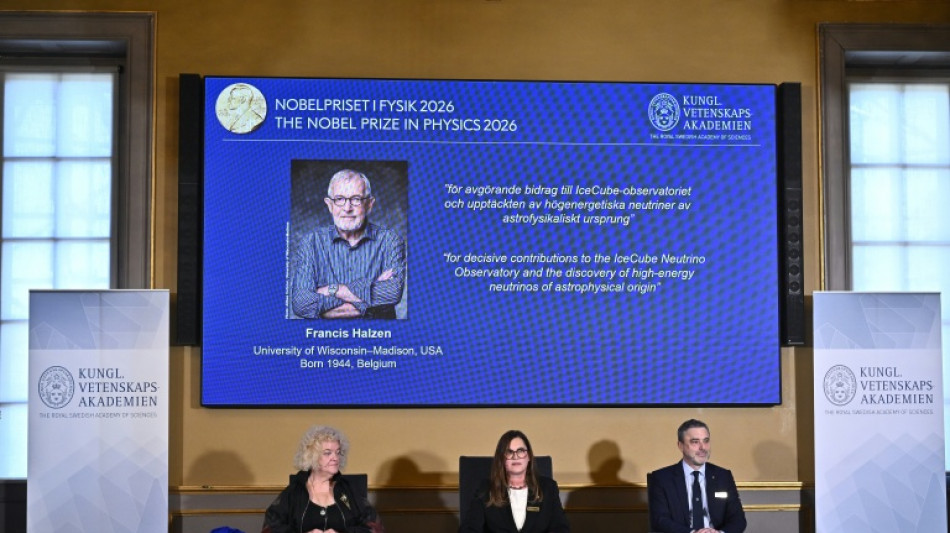
Nobel physics prize honours work on 'ghostly messengers' from outer space / Photo: © TT NEWS AGENCY/AFP

 London
 19 °C
19 °C
 Manchester
18 °C
Manchester
18 °C
 Glasgow
17 °C
Glasgow
17 °C
 Dublin
12 °C
Dublin
12 °C
 Belfast
13 °C
Belfast
13 °C
 Washington
 8 °C
8 °C
 Denver
 17 °C
17 °C
 Atlanta
17 °C
Atlanta
17 °C
 Dallas
 17 °C
17 °C
 Houston Texas
24 °C
Houston Texas
24 °C
 New Orleans
24 °C
New Orleans
24 °C
 El Paso
17 °C
El Paso
17 °C
 Phoenix
27 °C
Phoenix
27 °C
 Los Angeles
26 °C
San Diego
24 °C
San Francisco
16 °C
Chicago
12 °C
Minneapolis
Los Angeles
26 °C
San Diego
24 °C
San Francisco
16 °C
Chicago
12 °C
Minneapolis
 16 °C
Seattle
12 °C
Portland
14 °C
Salt Lake City
17 °C
Las Vegas
24 °C
Miami
25 °C
Jacksonville
24 °C
San Antonio
20 °C
Bermuda
27 °C
Nassau
9 °C
Iqaluit
16 °C
Seattle
12 °C
Portland
14 °C
Salt Lake City
17 °C
Las Vegas
24 °C
Miami
25 °C
Jacksonville
24 °C
San Antonio
20 °C
Bermuda
27 °C
Nassau
9 °C
Iqaluit
 0 °C
Yellowknife
6 °C
Anchorage
0 °C
Yellowknife
6 °C
Anchorage
 6 °C
Fairbanks
6 °C
Fairbanks
 1 °C
Barrow
-6 °C
Calgary
9 °C
Edmonton
9 °C
Winnipeg
5 °C
Goose Bay
5 °C
Halifax
7 °C
Boston
7 °C
Ottawa
4 °C
Toronto
5 °C
Detroit
6 °C
Cleveland
6 °C
New York
10 °C
Baltimore
8 °C
Philadelphia
8 °C
Nuuk (Godthåb)
1 °C
Barrow
-6 °C
Calgary
9 °C
Edmonton
9 °C
Winnipeg
5 °C
Goose Bay
5 °C
Halifax
7 °C
Boston
7 °C
Ottawa
4 °C
Toronto
5 °C
Detroit
6 °C
Cleveland
6 °C
New York
10 °C
Baltimore
8 °C
Philadelphia
8 °C
Nuuk (Godthåb)
 1 °C
Hong Kong
26 °C
Singapore
31 °C
Melbourne
25 °C
Canberra
12 °C
Adelaide
13 °C
Darwin
28 °C
Perth
20 °C
Fort Worth
17 °C
Honolulu
25 °C
Sydney
21 °C
Johannesburg
20 °C
Dubai
36 °C
Mumbai
32 °C
Zürich
22 °C
Tokyo
23 °C
Seoul
18 °C
Delhi
35 °C
Beijing
16 °C
Riyadh
38 °C
Prague
20 °C
Pennsylvania
7 °C
Valletta
26 °C
Manama
35 °C
Warsaw
21 °C
Stockholm
16 °C
1 °C
Hong Kong
26 °C
Singapore
31 °C
Melbourne
25 °C
Canberra
12 °C
Adelaide
13 °C
Darwin
28 °C
Perth
20 °C
Fort Worth
17 °C
Honolulu
25 °C
Sydney
21 °C
Johannesburg
20 °C
Dubai
36 °C
Mumbai
32 °C
Zürich
22 °C
Tokyo
23 °C
Seoul
18 °C
Delhi
35 °C
Beijing
16 °C
Riyadh
38 °C
Prague
20 °C
Pennsylvania
7 °C
Valletta
26 °C
Manama
35 °C
Warsaw
21 °C
Stockholm
16 °C
Belgian physicist Francis Halzen on Tuesday won the Nobel physics prize for groundbreaking work using South Pole ice to capture neutrinos originating in the distant cosmos, providing insight into the far reaches of space.
"This year's prize is about ghostly messengers from space," Ellen Moons, secretary general of the Royal Swedish Academy of Sciences, told a news conference.
Halzen was honoured "for decisive contributions to the IceCube Neutrino Observatory and the discovery of high-energy neutrinos of astrophysical origin", the jury said.
The Royal Swedish Academy of Sciences said Halzen's work had been fundamental for the observatory -- "a cubic kilometre of ice that is equipped with light sensors" -- and has "paved the way for a new kind of astronomy".
Using the observatory, researchers can capture neutrinos -- rare subatomic particles -- "from extremely energy-rich processes in the distant universe".
Halzen, 82, was born in Tienen, Belgium and is a professor at the University of Wisconsin–Madison in the United States, where he is a citizen.
"It was a great surprise, and I obviously didn't expect it," he told the news conference by telephone shortly after the prize was announced.
"But it's a great pleasure to hear about this prize," Halzen said.
- Courageous people -
The academy explained that high energy neutrinos are created in the same environments as other particles.
"However, unlike other particles, neutrinos reach us without changing direction or losing energy. This means they can provide information that is not available in any other way," it said in a statement.
Halzen first presented his idea for the observatory in 1988 and his idea quickly gained the support of other researchers.
Preliminary testing was conducted just a few years later but the observatory was not completed until 2011.
"Cosmic neutrinos with extremely high energies are very rare, so an enormous volume of ice is needed to observe an adequate number of collisions," the jury explained.
"For me, the main pleasure of it, besides winning the Nobel Prize, is that I hope this reflects on the really courageous people who joined me in the beginning of this project," Halzen said.
The award is the second Nobel of the season, after the medicine prize was awarded on Monday to US psychiatrist and neurologist Karl Deisseroth and German scientists Peter Hegemann and Georg Nagel.
The researchers were honoured for their pioneering work in the field of optogenetics, which involves controlling nerve signals with light.
- Peace prize lobbying -
Last year, the Nobel Prize in Physics went to Briton John Clarke, Frenchman Michel Devoret and American John Martinis for putting quantum mechanics into action and enabling the development of all kinds of digital technology from cellphones to a new generation of computers.
The physics prize will be followed by the chemistry one on Wednesday.
The literature laureate will be revealed on Thursday, with some pundits suggesting that the Swedish Academy could follow up last year's award to Hungary's Laszlo Krasznahorkai with a woman writer, possibly from Latin America.
The most keenly anticipated award -- the peace prize -- is due on Friday.
US President Donald Trump lobbied intensively last year to get the prize -- and Venezuelan opposition leader Maria Corina Machado ended up giving him her Nobel medal -- and the committee is aware he will be watching closely again.
The economics prize wraps up the Nobel season on October 12.
The Nobel consists of a diploma, a gold medal and a 12-million-kronor ($1.2-million) prize sum, which is shared if there is more than one winner in a discipline.
The laureates will receive their prizes at a formal ceremony on December 10, the anniversary of the death in 1896 of scientist Alfred Nobel, who created the prizes in his will.
G. Santana--JDB