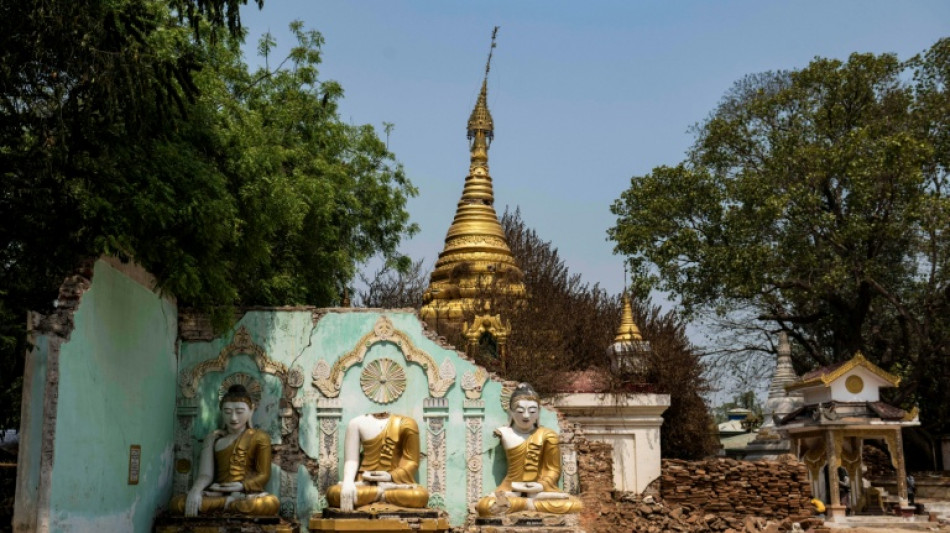
Myanmar's rebuild stutters year after deadly quake / Photo: © AFP

 London
 11 °C
11 °C

 Manchester
 12 °C
12 °C
 Glasgow
12 °C
Glasgow
12 °C
 Dublin
17 °C
Dublin
17 °C
 Belfast
15 °C
Belfast
15 °C
 Washington
23 °C
Washington
23 °C
 Denver
 16 °C
16 °C
 Atlanta
24 °C
Atlanta
24 °C
 Dallas
27 °C
Dallas
27 °C
 Houston Texas
28 °C
Houston Texas
28 °C
 New Orleans
27 °C
New Orleans
27 °C
 El Paso
26 °C
El Paso
26 °C
 Phoenix
33 °C
Phoenix
33 °C
 Los Angeles
20 °C
San Diego
21 °C
San Francisco
14 °C
Chicago
17 °C
Minneapolis
13 °C
Seattle
14 °C
Portland
18 °C
Salt Lake City
14 °C
Las Vegas
28 °C
Miami
Los Angeles
20 °C
San Diego
21 °C
San Francisco
14 °C
Chicago
17 °C
Minneapolis
13 °C
Seattle
14 °C
Portland
18 °C
Salt Lake City
14 °C
Las Vegas
28 °C
Miami
 25 °C
Jacksonville
24 °C
San Antonio
27 °C
Bermuda
27 °C
Nassau
19 °C
Iqaluit
2 °C
Yellowknife
14 °C
Anchorage
10 °C
Fairbanks
8 °C
Barrow
-1 °C
Calgary
12 °C
Edmonton
24 °C
Winnipeg
12 °C
Goose Bay
13 °C
Halifax
16 °C
Boston
15 °C
Ottawa
12 °C
Toronto
14 °C
Detroit
16 °C
Cleveland
17 °C
New York
19 °C
Baltimore
23 °C
Philadelphia
19 °C
Nuuk (Godthåb)
1 °C
Hong Kong
25 °C
Jacksonville
24 °C
San Antonio
27 °C
Bermuda
27 °C
Nassau
19 °C
Iqaluit
2 °C
Yellowknife
14 °C
Anchorage
10 °C
Fairbanks
8 °C
Barrow
-1 °C
Calgary
12 °C
Edmonton
24 °C
Winnipeg
12 °C
Goose Bay
13 °C
Halifax
16 °C
Boston
15 °C
Ottawa
12 °C
Toronto
14 °C
Detroit
16 °C
Cleveland
17 °C
New York
19 °C
Baltimore
23 °C
Philadelphia
19 °C
Nuuk (Godthåb)
1 °C
Hong Kong
 31 °C
Singapore
33 °C
Melbourne
24 °C
Canberra
31 °C
Singapore
33 °C
Melbourne
24 °C
Canberra
 20 °C
Adelaide
16 °C
Darwin
31 °C
Perth
22 °C
Fort Worth
26 °C
Honolulu
20 °C
Adelaide
16 °C
Darwin
31 °C
Perth
22 °C
Fort Worth
26 °C
Honolulu
 27 °C
Sydney
19 °C
Johannesburg
13 °C
Dubai
34 °C
Mumbai
31 °C
Zürich
15 °C
Tokyo
27 °C
Sydney
19 °C
Johannesburg
13 °C
Dubai
34 °C
Mumbai
31 °C
Zürich
15 °C
Tokyo
 22 °C
Seoul
30 °C
Delhi
32 °C
Beijing
30 °C
Riyadh
31 °C
Prague
10 °C
Pennsylvania
19 °C
Valletta
24 °C
Manama
33 °C
Warsaw
11 °C
Stockholm
22 °C
Seoul
30 °C
Delhi
32 °C
Beijing
30 °C
Riyadh
31 °C
Prague
10 °C
Pennsylvania
19 °C
Valletta
24 °C
Manama
33 °C
Warsaw
11 °C
Stockholm
 11 °C
11 °C
The gaping holes torn in a road to Mandalay by last year's devastating earthquake have been filled in, and the route in northern Myanmar partly resurfaced.
But only a few of the broken spans of the historic Ava Bridge have been removed, while the others still droop into the river where hundreds of newly homeless people bathed in the aftermath of the disaster.
More than 3,800 people in Myanmar -- and around 90 more in neighbouring Thailand -- were killed when the 7.7-magnitude tremor struck on March 28, 2025.
AFP was the only international news agency on the ground in Myanmar's capital Naypyidaw when the quake hit, with its team the first international journalists to reach the city of Mandalay.
A year on, reporters returning to the affected areas found a mixed picture of reconstruction work.
In Naypyidaw, the collapsed concrete awning of the main hospital's emergency department -- which crushed a car when it came down -- has been replaced with a new, lighter structure, with a plastic roof.
A rare unguarded photo of junta chief Min Aung Hlaing, looking flustered as he sought to direct rescue efforts at the hospital, was one of many by AFP that captured the destruction after the quake, which came during a years-long civil war.
Mandalay, an ancient royal capital hemmed by jungle-clad mountains and the snaking Irrawaddy river, bore the brunt of the damage.
At a pagoda in the suburb of Amarapura, a statue of a reclining Buddha emerges from a carefully arranged pile of brick rubble, its face respectfully cleaned.
"Some are rebuilding their houses, while others are just now getting the support they need to work and live," said board secretary Hsan Tun, 70.
Four people died at the pagoda, he added, including a girl who was meditating. "It's only by the Buddha's protection that we survived."
Almost all of Mandalay's flattened or toppled residential buildings have been cleared away, some of them already rebuilt and others remaining as fenced-off empty lots dotting the city.
The tilted-over towers overlooking the palace moat have all been brought back upright, and workers are building new brick castellations for their supporting ramparts.
After the quake, thousands of people whose homes had been made uninhabitable or who feared aftershocks slept out for weeks by the moat, but it is once again the preserve of morning joggers and sightseers.
- 'When the sky falls' -
Some of the buildings at the Thahtay Kyaung monastery, where saffron-clad monks cleared rubble from the wreckage by hand in the days after the quake, have been razed.
"People are facing many economic hardships," said the abbot, U Thudassa. "Like the saying, 'When the sky falls, it falls on everyone'."
"We build as much as we can with what we have," added the 70-year-old. "We cannot just stand still; natural disasters will always be a part of life."
At Amarapura's Nagayon Pagoda, a Buddha statue reduced to just two legs and hands on a pedestal has been fully restored, looking out with a serene gaze.
In nearby Bon Oe village, the quake caused a mosque to collapse onto worshippers gathered for the noon prayer on the last Friday of Ramadan, killing many.
A permanent replacement has yet to be erected -- government approval is needed for religious buildings, and it has not yet been granted.
Instead, men gather for evening prayers in a temporary structure covered in green tarpaulins and with palm leaves for a roof.
"Yesterday marked one year" since disaster struck, said mosque leader Khin Maung Naing, counting by the Islamic calendar.
"Everyone still trembles at any loud noise," he added.
"Even after a year, the tremor, the scenes and the feelings from that earthquake feel as if they happened only yesterday or the day before. To this day, it remains in my heart."
D. Barbosa--JDB