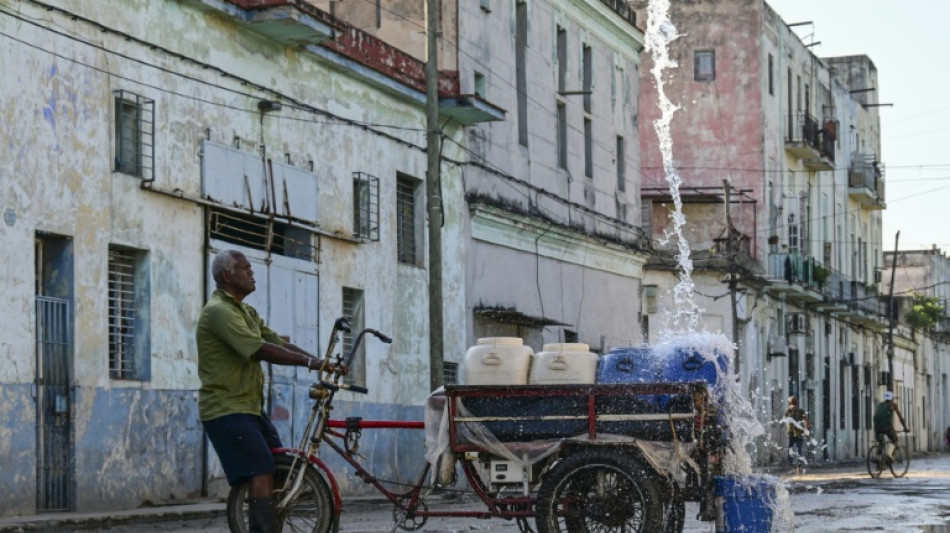
'Daily struggle': Cubans dig wells in search of water / Photo: © AFP

 London
 10 °C

 Manchester
 9 °C
 Glasgow
 8 °C
 Dublin
7 °C
 Belfast
11 °C
 Washington
 11 °C
 Denver
13 °C
 Atlanta
12 °C
 Dallas
17 °C
 Houston Texas
22 °C
 New Orleans
18 °C
 El Paso
20 °C
 Phoenix
27 °C
 Los Angeles
19 °C
San Diego
20 °C
San Francisco
16 °C
Chicago
12 °C
Minneapolis
12 °C
Seattle
9 °C
Portland
13 °C
Salt Lake City
14 °C
Las Vegas
23 °C
Miami
23 °C
Jacksonville
15 °C
San Antonio
17 °C
Bermuda
24 °C
Nassau
12 °C
Iqaluit
-5 °C
Yellowknife
4 °C
Anchorage
 3 °C
Fairbanks
 -3 °C
Barrow
-3 °C
Calgary
2 °C
Edmonton
8 °C
Winnipeg
8 °C
Goose Bay
3 °C
Halifax
 12 °C
Boston
9 °C
Ottawa
4 °C
Toronto
8 °C
Detroit
7 °C
Cleveland
9 °C
New York
12 °C
Baltimore
12 °C
Philadelphia
11 °C
Nuuk (Godthåb)
-5 °C
Hong Kong
 31 °C
Singapore
32 °C
Melbourne
20 °C
Canberra
22 °C
Adelaide
27 °C
Darwin
34 °C
Perth
 22 °C
Fort Worth
17 °C
Honolulu
25 °C
Sydney
 23 °C
Johannesburg
19 °C
Dubai
34 °C
Mumbai
35 °C
Zürich
10 °C
Tokyo
28 °C
Seoul
16 °C
Delhi
29 °C
Beijing
16 °C
Riyadh
30 °C
Prague
6 °C
Pennsylvania
7 °C
Valletta
24 °C
Manama
33 °C
Warsaw
12 °C
Stockholm
10 °C
Kevin Martinez has come up with a creative new way to avoid shutting his restaurant when water runs low in Cuba, a common source of frustration for the business owner.
The US energy blockade on the communist-run island has caused problems along the line of supply, so Martinez decided to drill downwards and find his own source.
His business is located in the Matanzas province, 100 kilometers (62 miles) east of Havana and one of the regions particularly affected by the shortages.
The issue affects nearly 29 percent of Cuba's 9.4 million inhabitants, according to official figures, with the situation worsening significantly since January due to the US energy blockade.
The subsequent crisis has made prolonged blackouts the norm, which in turn reduces the water supply, as pumping depends primarily on electric turbines.
"On several occasions we had to close the establishment because we didn't have any water...and that's what brought us to the point of having to dig the well," Martinez told AFP.
"I never imagined I'd have to be digging a well, just as I never imagined I'd have to be cooking with coal or installing solar panels," he said.
The decision to drill, although "a bit expensive," sets him free from paying for water deliveries three times a week.
- 'Daily struggle' -
Water does not reach the homes of 2.7 million Cubans, Yunior Gonzalez, a senior official at the national water company, told AFP.
"Between 80 and 85 percent of the water" supplied has to be pumped to get to these households, he said, adding that equipment breakdowns, leaks and drought have exacerbated the problem.
Water difficulties are forcing many Cubans to haul the precious resource for long distances, transporting it via wheelbarrows, bicycles, car trunks and even horse-drawn carts.
Maykel Aguilar, 30, patiently filled a 200-liter tank and several buckets at a pipe connected to a spring on a street in the capital's old town.
He then must use a wheelbarrow to get it to his home before heaving it up a flight of stairs.
"One little trip like that is enough for a load of laundry, cleaning the house, and cooking, and just like that you're out of water," Aguilar said.
Neighbors line up in the same spot, marking their place with tanks, buckets and jerrycans.
"The power outages here happen every day and we have to keep hauling water," said 40-year-old mother of two Yusimy Guerra.
"It's a daily struggle," she sighed.
Water scarcity adds to Cuba's runaway inflation, while food and medicine also run low amid mounting social unrest.
Municipalities in Havana have recorded several women-led protests over water shortages in recent months.
- 'Thieves' -
More and more Cubans are drilling wells on their properties, building cisterns in their yards, installing tanks and even resorting to so‑called "water thieves" -- pumps that suck the trickle of water from the mains and force it into their homes.
Several of these installations in the same neighborhood can reduce the pressure in the network and make it even harder for other households to access water.
Well digger Elizardo Cardoso, who found water 10 meters below the ground at Martinez's restaurant, says his trade is in high demand.
Water agent Gonzalez meanwhile said the government is moving forward with transforming the sector's energy mix as a way to reduce dependence on the faulty national power grid.
More than 870 solar-powered water pumps have already been installed out of the 1,300 planned, benefiting half a million Cubans across the country, he said.
The Albear Aqueduct, one of Havana's main sources of water supply, recently gained two brand-new, gigantic backup generators that run on diesel.
But "they are very expensive programs," Gonzalez cautioned.
A. Martins--JDB