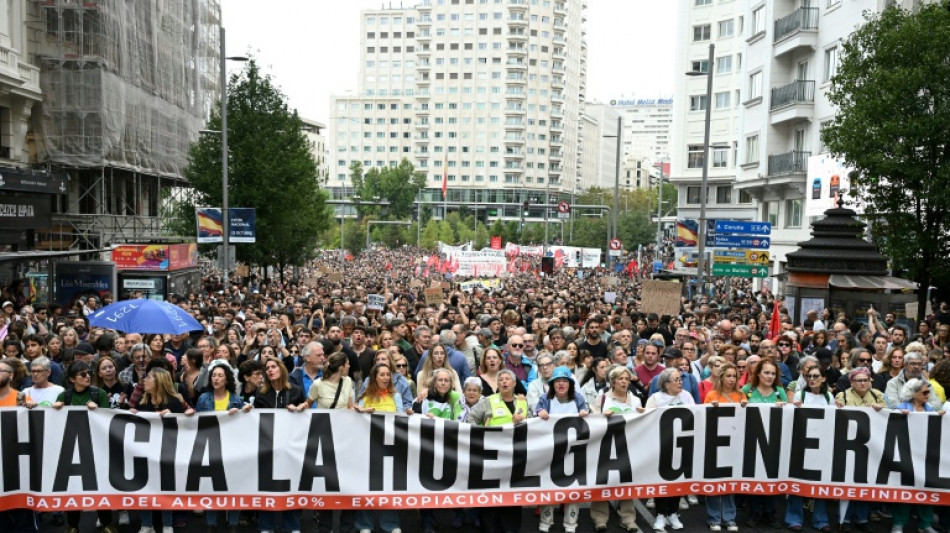
Housing crisis set to dominate Spain's snap election / Photo: © AFP

 London
 8 °C
8 °C

 Manchester
7 °C
Manchester
7 °C
 Glasgow
 13 °C
13 °C
 Dublin
 7 °C
7 °C
 Belfast
9 °C
Belfast
9 °C
 Washington
16 °C
Washington
16 °C
 Denver
 21 °C
21 °C
 Atlanta
19 °C
Atlanta
19 °C
 Dallas
24 °C
Dallas
24 °C
 Houston Texas
29 °C
Houston Texas
29 °C
 New Orleans
26 °C
New Orleans
26 °C
 El Paso
27 °C
El Paso
27 °C
 Phoenix
35 °C
Phoenix
35 °C
 Los Angeles
30 °C
San Diego
29 °C
San Francisco
Los Angeles
30 °C
San Diego
29 °C
San Francisco
 18 °C
Chicago
20 °C
Minneapolis
16 °C
Seattle
16 °C
Portland
22 °C
Salt Lake City
23 °C
Las Vegas
34 °C
Miami
18 °C
Chicago
20 °C
Minneapolis
16 °C
Seattle
16 °C
Portland
22 °C
Salt Lake City
23 °C
Las Vegas
34 °C
Miami
 26 °C
Jacksonville
25 °C
San Antonio
27 °C
Bermuda
25 °C
Nassau
15 °C
Iqaluit
0 °C
Yellowknife
5 °C
Anchorage
10 °C
Fairbanks
3 °C
Barrow
-7 °C
Calgary
12 °C
Edmonton
20 °C
Winnipeg
10 °C
Goose Bay
14 °C
Halifax
12 °C
Boston
13 °C
Ottawa
14 °C
Toronto
18 °C
Detroit
20 °C
Cleveland
20 °C
New York
16 °C
Baltimore
16 °C
Philadelphia
15 °C
Nuuk (Godthåb)
3 °C
Hong Kong
27 °C
Singapore
26 °C
Jacksonville
25 °C
San Antonio
27 °C
Bermuda
25 °C
Nassau
15 °C
Iqaluit
0 °C
Yellowknife
5 °C
Anchorage
10 °C
Fairbanks
3 °C
Barrow
-7 °C
Calgary
12 °C
Edmonton
20 °C
Winnipeg
10 °C
Goose Bay
14 °C
Halifax
12 °C
Boston
13 °C
Ottawa
14 °C
Toronto
18 °C
Detroit
20 °C
Cleveland
20 °C
New York
16 °C
Baltimore
16 °C
Philadelphia
15 °C
Nuuk (Godthåb)
3 °C
Hong Kong
27 °C
Singapore
 30 °C
Melbourne
24 °C
Canberra
15 °C
Adelaide
26 °C
Darwin
30 °C
Perth
17 °C
Fort Worth
24 °C
Honolulu
28 °C
Sydney
19 °C
Johannesburg
14 °C
Dubai
33 °C
Mumbai
29 °C
Zürich
13 °C
Tokyo
30 °C
Melbourne
24 °C
Canberra
15 °C
Adelaide
26 °C
Darwin
30 °C
Perth
17 °C
Fort Worth
24 °C
Honolulu
28 °C
Sydney
19 °C
Johannesburg
14 °C
Dubai
33 °C
Mumbai
29 °C
Zürich
13 °C
Tokyo
 22 °C
Seoul
20 °C
Delhi
25 °C
Beijing
19 °C
Riyadh
29 °C
Prague
10 °C
Pennsylvania
14 °C
Valletta
24 °C
Manama
31 °C
Warsaw
12 °C
Stockholm
9 °C
22 °C
Seoul
20 °C
Delhi
25 °C
Beijing
19 °C
Riyadh
29 °C
Prague
10 °C
Pennsylvania
14 °C
Valletta
24 °C
Manama
31 °C
Warsaw
12 °C
Stockholm
9 °C
After simmering below the surface for years, anger at unaffordable housing in Spain has bubbled over and precipitated a general election that will be dominated by the crisis.
The spark was ignited on September 23 when 87-year-old Maricarmen Abascal was evicted from her lifelong Madrid home on a stretcher after the real estate firm that owned the apartment drastically hiked the rent.
Abascal, who died on Wednesday, became the symbol of a crisis that cuts across Spanish society: young and old, renters and buyers, workers and pensioners.
The uproar at her eviction triggered national demonstrations, with hundreds of people camping in central Madrid's Puerta del Sol square in the most symbolic protest.
As in other European countries, housing has long been a top public concern, particularly for young adults who are priced out of the market and stay with their parents into their 30s and beyond.
Growth in housing prices has far outstripped wages in recent years, eating up far more than the upper limit of 30 percent of income recommended by public bodies and housing professionals.
According to the latest figures by the National Statistics Institute (INE), the average gross monthly salary in Spain is around 2,460 euros ($2,750).
Renting a 50-square-metre (538-square-foot) apartment in Madrid cost on average 1,170 euros per month in September, according to real estate portal Idealista -- around half of a normal income.
- 'Society of inheritors' -
Many residents in popular destinations like Barcelona complain that short-term tourist accommodation is limiting supply and driving up prices.
Investment funds with large housing portfolios are another much-maligned group, accused of being "vulture funds" that acquire properties and hike rents for maximum profits.
A tiny public housing supply is another major factor, with Madrid representing an extreme example of the phenomenon.
A paradise for luxury real estate, the capital only has around 10,000 social housing units for its 3.5 million inhabitants.
Such is the demand for them that some public apartments are allocated by lottery.
A history of home ownership partly explains the small public housing stock. Under the dictatorship of General Francisco Franco (1939-1975), a housing minister said he wanted "a country of owners and not proletarians".
But the model is breaking down, especially for the young. While almost three in four households own their main residence, more than half of under-30s rented in 2025, according to the INE.
Jorge Galindo, director of the Centre for Economic Policy at Esade business school, said the 2008 global financial crash was a turning point for the Spanish housing market.
The bursting of a real estate bubble sparked the "collapse" of construction and "the destruction of a million jobs" in the sector, Galindo told AFP.
Since then, "supply has not kept up", falling from around 260,000 new builds per year in the 1990s to 92,000 in 2025, he said.
The expert warned that the country of around 50 million people risked becoming "a society of inheritors" in which home ownership depends on parents passing property to their children.
- Political upheaval -
How to solve a puzzle that has bedevilled successive governments will be a central debate of the snap election that Socialist Prime Minister Pedro Sanchez called for November 29.
Last week, Sanchez's leftist coalition proposed a series of measures including more restrictions on evictions, a ban on the "speculative" purchase of homes and the automatic renewal of tenant contracts.
But the minority government failed to pass them in parliament, leading Sanchez to call an early vote originally scheduled for 2027.
Spain's main unions have called a general strike for November 11 in large part due to the political paralysis over housing.
In 2023, Sanchez's government passed a law that provided for more social housing, the regulation of rents in areas under the greatest stress, and punishments for owners who left their properties empty.
But the law has not stopped the spiralling prices and popular discontent.
The main opposition right-wing Popular Party advocates a building boom to make up the deficit between supply and demand.
For Galindo, the debate contains a "paradox".
"Those who suffer most from the housing crisis are those with the least weight at the ballot box: young people, who vote less, and immigrants."
M. Silva--JDB