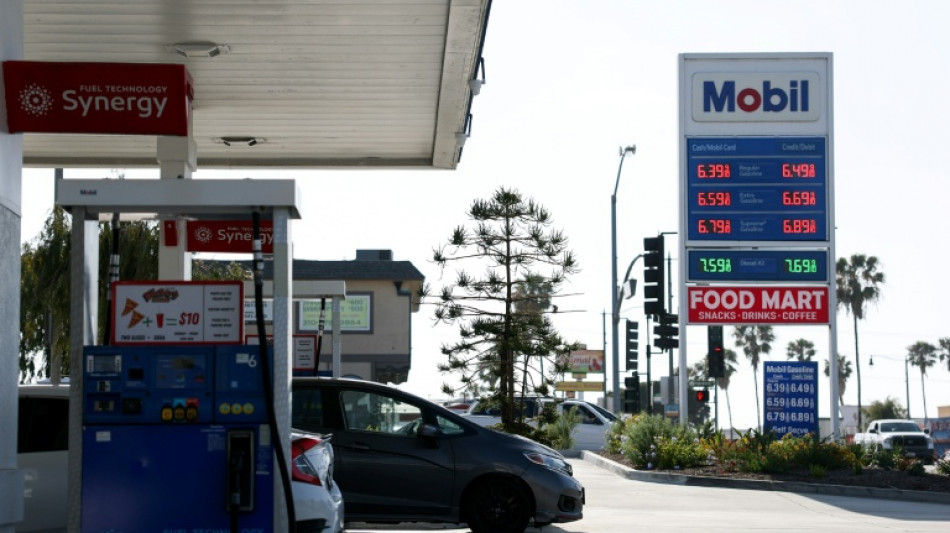
US revises first quarter growth down while inflation climbs / Photo: © AFP/File

 London
 20 °C
20 °C
 Manchester
19 °C
Manchester
19 °C
 Glasgow
16 °C
Glasgow
16 °C
 Dublin
 18 °C
18 °C
 Belfast
16 °C
Belfast
16 °C
 Washington
21 °C
Washington
21 °C
 Denver
21 °C
Denver
21 °C
 Atlanta
 24 °C
24 °C
 Dallas
30 °C
Dallas
30 °C
 Houston Texas
 31 °C
31 °C
 New Orleans
27 °C
New Orleans
27 °C
 El Paso
28 °C
El Paso
28 °C
 Phoenix
34 °C
Phoenix
34 °C
 Los Angeles
21 °C
San Diego
21 °C
San Francisco
16 °C
Chicago
16 °C
Minneapolis
14 °C
Seattle
20 °C
Portland
20 °C
Salt Lake City
23 °C
Las Vegas
Los Angeles
21 °C
San Diego
21 °C
San Francisco
16 °C
Chicago
16 °C
Minneapolis
14 °C
Seattle
20 °C
Portland
20 °C
Salt Lake City
23 °C
Las Vegas
 34 °C
Miami
29 °C
Jacksonville
26 °C
San Antonio
29 °C
Bermuda
27 °C
Nassau
19 °C
Iqaluit
5 °C
Yellowknife
16 °C
Anchorage
34 °C
Miami
29 °C
Jacksonville
26 °C
San Antonio
29 °C
Bermuda
27 °C
Nassau
19 °C
Iqaluit
5 °C
Yellowknife
16 °C
Anchorage
 12 °C
Fairbanks
12 °C
Barrow
1 °C
Calgary
18 °C
Edmonton
17 °C
Winnipeg
19 °C
Goose Bay
12 °C
Halifax
16 °C
Boston
17 °C
Ottawa
12 °C
Toronto
13 °C
Detroit
14 °C
Cleveland
13 °C
New York
21 °C
Baltimore
21 °C
Philadelphia
21 °C
Nuuk (Godthåb)
12 °C
Fairbanks
12 °C
Barrow
1 °C
Calgary
18 °C
Edmonton
17 °C
Winnipeg
19 °C
Goose Bay
12 °C
Halifax
16 °C
Boston
17 °C
Ottawa
12 °C
Toronto
13 °C
Detroit
14 °C
Cleveland
13 °C
New York
21 °C
Baltimore
21 °C
Philadelphia
21 °C
Nuuk (Godthåb)
 8 °C
Hong Kong
32 °C
Singapore
8 °C
Hong Kong
32 °C
Singapore
 30 °C
Melbourne
27 °C
Canberra
7 °C
Adelaide
12 °C
Darwin
29 °C
Perth
30 °C
Melbourne
27 °C
Canberra
7 °C
Adelaide
12 °C
Darwin
29 °C
Perth
 18 °C
Fort Worth
30 °C
Honolulu
25 °C
Sydney
15 °C
Johannesburg
14 °C
Dubai
35 °C
Mumbai
27 °C
Zürich
20 °C
Tokyo
35 °C
Seoul
28 °C
Delhi
34 °C
Beijing
28 °C
Riyadh
42 °C
Prague
16 °C
Pennsylvania
15 °C
Valletta
28 °C
Manama
36 °C
Warsaw
19 °C
Stockholm
15 °C
18 °C
Fort Worth
30 °C
Honolulu
25 °C
Sydney
15 °C
Johannesburg
14 °C
Dubai
35 °C
Mumbai
27 °C
Zürich
20 °C
Tokyo
35 °C
Seoul
28 °C
Delhi
34 °C
Beijing
28 °C
Riyadh
42 °C
Prague
16 °C
Pennsylvania
15 °C
Valletta
28 °C
Manama
36 °C
Warsaw
19 °C
Stockholm
15 °C
The US economy expanded less than initially estimated in the first quarter, government data showed Thursday, while a key inflation gauge separately hit a three-year high on fallout from the Middle East war.
The figures sound a warning on pressures that American households are facing ahead of midterm elections, as steeper gasoline prices squeeze budgets and a boost from tax refunds fades.
Gross domestic product in the world's biggest economy rose at an annual rate of 1.6 percent in the first three months this year, the Commerce Department said.
This was down from an earlier estimate of 2.0 percent, with the pullback "primarily reflecting downward revisions to investment and consumer spending," the department added.
"New data showed services spending, particularly on medical services, slowed and business inventories fell by more than previously estimated," said economist Michael Pearce of Oxford Economics.
Downward revisions to consumer spending in the first quarter, alongside a slowdown in April, "point to a consumer coming under stress," he added.
Pearce was referring to another report that showed the US Federal Reserve's preferred inflation measure rising to its highest year-on-year rate since 2023.
The personal consumption expenditures (PCE) price index increased 3.8 percent from a year ago, the Commerce Department said, up from 3.5 percent in March.
US personal consumption expenditures rose by 0.5 percent in April, but disposable personal income fell by 0.1 percent.
"You can see how Americans are getting squeezed financially right now," said Heather Long, chief economist at Navy Federal Credit Union.
Pearce expects that higher energy prices are likely to keep GDP growth "moderate this year."
Energy costs have surged following US-Israeli strikes targeting Iran on February 28, engulfing the Middle East in conflict and triggering Tehran's retaliation that has virtually blocked the Strait of Hormuz.
The key waterway normally sees about a fifth of the world's oil and gas supplies pass through it, and is also essential for the global fertilizer trade.
Global costs have soared, with prices at American gasoline stations also spiking -- piling pressure on consumers ahead of elections at the end of the year.
Rising fuel prices saw US consumers spend $28.8 billion more on gasoline and related products in April over the same month a year ago, the data showed.
- Spending power eroded -
"Remember that 70 percent of the US economy is consumer spending," said ING chief international economist James Knightley in a note.
Higher gasoline prices are not just an inflation problem but will weigh on economic activity too, he warned.
EY-Parthenon chief economist Gregory Daco added: "Household budgets are coming under mounting pressure from rising inflation and a softer income backdrop, while slower wage and job growth continue to weigh on purchasing power."
"As a result, we expect spending momentum to cool," he said.
More broadly, analysts have warned of the country's reliance on an AI investment boom to fuel growth, alongside consumer fatigue as the energy shock from the war on Iran lingers.
Still, growth accelerated from a 0.5 percent rate in the fourth quarter of 2025.
The step up between the final months of 2025 and early 2026 was attributed to "upturns in government spending and exports and an acceleration in investment," while consumer spending decelerated.
Adding to the gloomy data was another government report showing that sales of new US homes pulled back in April, as higher costs weighed on consumers.
Sales came in at a seasonally-adjusted annual rate of 622,000, the Commerce Department said, 6.2 percent below March's rate of 663,000.
This was 11.3 percent lower than the pace seen a year ago, as the median sales price of new houses rose 8.0 percent from March and mortgage rates continue to climb.
As of the week of May 21, the popular 30-year fixed-rate mortgage averaged 6.5 percent, up from levels seen in the prior month.
P. Duarte--JDB