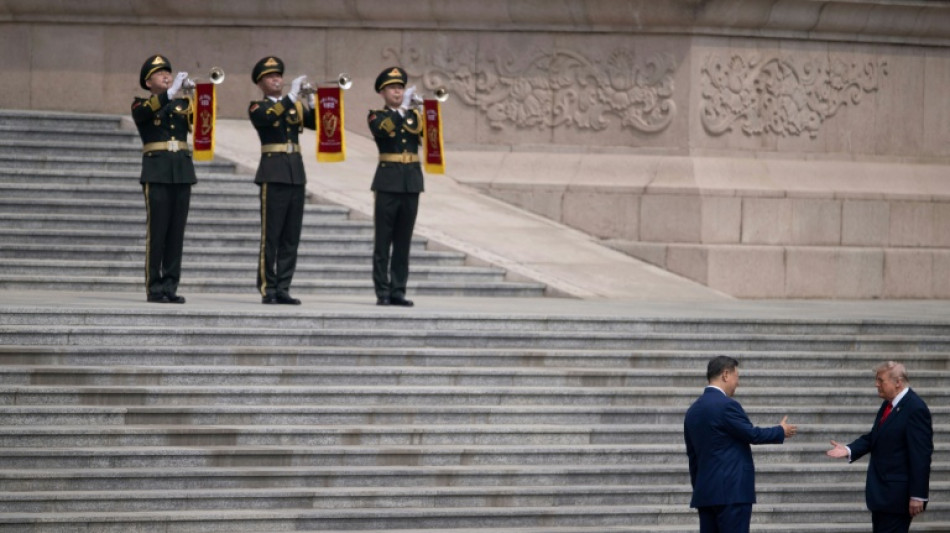
Xi's 'blunt' warning to Trump on Taiwan exposes profound risks: analysts / Photo: © AFP

 London
 20 °C
20 °C

 Manchester
 19 °C
19 °C
 Glasgow
20 °C
Glasgow
20 °C
 Dublin
 18 °C
18 °C
 Belfast
16 °C
Belfast
16 °C
 Washington
20 °C
Washington
20 °C
 Denver
24 °C
Denver
24 °C
 Atlanta
23 °C
Atlanta
23 °C
 Dallas
29 °C
Dallas
29 °C
 Houston Texas
27 °C
Houston Texas
27 °C
 New Orleans
26 °C
New Orleans
26 °C
 El Paso
 29 °C
29 °C
 Phoenix
39 °C
Phoenix
39 °C
 Los Angeles
22 °C
San Diego
Los Angeles
22 °C
San Diego
 20 °C
San Francisco
15 °C
Chicago
20 °C
Minneapolis
22 °C
Seattle
17 °C
Portland
18 °C
Salt Lake City
25 °C
Las Vegas
36 °C
Miami
20 °C
San Francisco
15 °C
Chicago
20 °C
Minneapolis
22 °C
Seattle
17 °C
Portland
18 °C
Salt Lake City
25 °C
Las Vegas
36 °C
Miami
 28 °C
Jacksonville
26 °C
San Antonio
26 °C
Bermuda
27 °C
Nassau
18 °C
Iqaluit
28 °C
Jacksonville
26 °C
San Antonio
26 °C
Bermuda
27 °C
Nassau
18 °C
Iqaluit
 7 °C
Yellowknife
16 °C
Anchorage
14 °C
Fairbanks
11 °C
Barrow
5 °C
Calgary
19 °C
Edmonton
20 °C
Winnipeg
17 °C
Goose Bay
15 °C
Halifax
14 °C
Boston
16 °C
Ottawa
16 °C
Toronto
16 °C
Detroit
16 °C
Cleveland
17 °C
New York
21 °C
Baltimore
20 °C
Philadelphia
18 °C
Nuuk (Godthåb)
8 °C
Hong Kong
7 °C
Yellowknife
16 °C
Anchorage
14 °C
Fairbanks
11 °C
Barrow
5 °C
Calgary
19 °C
Edmonton
20 °C
Winnipeg
17 °C
Goose Bay
15 °C
Halifax
14 °C
Boston
16 °C
Ottawa
16 °C
Toronto
16 °C
Detroit
16 °C
Cleveland
17 °C
New York
21 °C
Baltimore
20 °C
Philadelphia
18 °C
Nuuk (Godthåb)
8 °C
Hong Kong
 27 °C
Singapore
29 °C
Melbourne
27 °C
Canberra
8 °C
Adelaide
14 °C
Darwin
30 °C
Perth
20 °C
Fort Worth
28 °C
Honolulu
25 °C
Sydney
16 °C
Johannesburg
10 °C
Dubai
35 °C
Mumbai
29 °C
Zürich
23 °C
Tokyo
30 °C
Seoul
29 °C
Delhi
35 °C
Beijing
32 °C
Riyadh
40 °C
Prague
21 °C
Pennsylvania
17 °C
Valletta
27 °C
Manama
36 °C
Warsaw
22 °C
Stockholm
17 °C
27 °C
Singapore
29 °C
Melbourne
27 °C
Canberra
8 °C
Adelaide
14 °C
Darwin
30 °C
Perth
20 °C
Fort Worth
28 °C
Honolulu
25 °C
Sydney
16 °C
Johannesburg
10 °C
Dubai
35 °C
Mumbai
29 °C
Zürich
23 °C
Tokyo
30 °C
Seoul
29 °C
Delhi
35 °C
Beijing
32 °C
Riyadh
40 °C
Prague
21 °C
Pennsylvania
17 °C
Valletta
27 °C
Manama
36 °C
Warsaw
22 °C
Stockholm
17 °C
Chinese leader Xi Jinping's unusually "blunt" warning to US President Donald Trump over Taiwan at Thursday's summit in Beijing exposes potentially grave pitfalls in the relationship, although its immediate impact could be limited, analysts say.
US sales of military equipment to the self-ruled island claimed by Beijing have long enraged the Chinese government, threatening to derail already-fraught engagement on trade and other issues between the world's top two economies.
China has vowed to bring Taiwan under its control, by force if necessary, while the United States -- which diplomatically recognises only Beijing -- is required under domestic law to provide weapons to the democratic island so that it can defend itself.
Xi warned Trump on Thursday that "the Taiwan question is the most important issue" in their bilateral relationship, according to remarks published by Chinese state media soon after the talks began.
"If mishandled, the two nations could collide or even come into conflict, pushing the entire China-US relationship into a highly perilous situation," he said.
Such "blunt" rhetoric is "out of the ordinary" coming from Xi in conversation with a US president, Adam Ni, editor of the China Neican newsletter, told AFP.
"Xi wants to make it very clear to Trump and to the public record that he thinks the Taiwan issue is the potential powder keg between the two superpowers," Ni said.
Chong Ja Ian of the National University of Singapore said China "has been signalling a desire for US compromise on Taiwan in the lead-up to the summit".
"Perhaps they see some opportunity to convince Trump," Chong said.
"So far, the US side has not indicated any movement."
- 'No consensus yet' -
Trump has not commented publicly on Taiwan since arriving in Beijing on Wednesday evening.
He ignored multiple questions on the subject from reporters during a visit to the Temple of Heaven on Thursday afternoon, where he and Xi posed for photographs after talks.
A readout of the meeting from a White House official also made no mention of Taiwan.
Treasury Secretary Scott Bessent said Trump would say more on Taiwan "in the coming days", adding that the president "understands the sensitivities" about the island.
Trump said days before the trip that he would discuss US arms sales to Taiwan with Xi -- something that would be a break with a decades-long policy of not consulting with Beijing on the issue.
Secretary of State Marco Rubio, who is also in Beijing and known for his firm line on China as a senator, suggested continuity in an interview with Fox News aboard Air Force One.
"It's not in China's interest or anyone's interest for there to be any sort of forced change in the status quo. I think stability there is very important," he said.
Tzeng Wei-feng of the National Chengchi University's Institute of International Relations in Taipei told AFP that he thinks Xi and Trump "don't have a consensus yet" on the issue of arms sales.
While a deal on that sensitive subject is unlikely, Tzeng said, it's possible that Trump will make "some statement that weakens the United States' promise on defending Taiwan".
- 'Non-negotiable' -
Trump repeatedly touted his personal relationship with Xi in the run-up to the summit, praising him as "a Leader of extraordinary distinction" in a social media post on Tuesday.
Many observers say Trump is placing great stock in his ability to cash in on that rapport during the summit.
Casting a shadow over talks is the unresolved US-Israeli war with Iran, which previously delayed Trump's visit to China -- the top customer of Iranian oil.
Speculation has emerged that Trump would seek to use US arms sales to Taiwan as a bargaining chip to encourage Beijing to use its leverage with Tehran to accept a deal to end the war.
However, Ryan Hass, an expert on China and Taiwan at the Washington-based Brookings Institution, threw cold water on the proposition.
"Doing so would violate Beijing's longstanding principle that Taiwan is 'non-negotiable'. It isn't how Beijing rolls," he wrote on social media.
"More likely, both leaders will affirm their shared interest in stabilising relations and use (economic and) commercial deals to demonstrate progress."
burs-pfc-ehl/dhw/pbt
L. Rodrigues--JDB