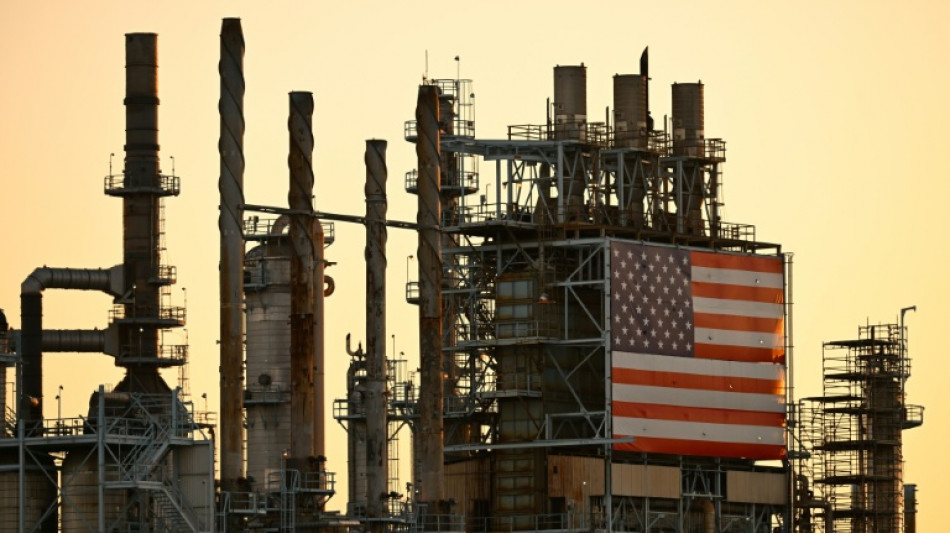
US reports firm Q2 economic growth, inflation steady / Photo: © AFP/File

 London
 24 °C
24 °C

 Manchester
 21 °C
21 °C
 Glasgow
23 °C
Glasgow
23 °C
 Dublin
18 °C
Dublin
18 °C
 Belfast
 17 °C
17 °C
 Washington
 20 °C
20 °C
 Denver
14 °C
Denver
14 °C
 Atlanta
 17 °C
17 °C
 Dallas
26 °C
Dallas
26 °C
 Houston Texas
28 °C
Houston Texas
28 °C
 New Orleans
27 °C
New Orleans
27 °C
 El Paso
17 °C
El Paso
17 °C
 Phoenix
20 °C
Phoenix
20 °C
 Los Angeles
 19 °C
San Diego
20 °C
San Francisco
19 °C
San Diego
20 °C
San Francisco
 15 °C
Chicago
16 °C
Minneapolis
18 °C
Seattle
10 °C
Portland
15 °C
Salt Lake City
13 °C
Las Vegas
20 °C
Miami
28 °C
Jacksonville
26 °C
San Antonio
26 °C
Bermuda
27 °C
Nassau
18 °C
Iqaluit
3 °C
Yellowknife
1 °C
Anchorage
3 °C
Fairbanks
0 °C
Barrow
15 °C
Chicago
16 °C
Minneapolis
18 °C
Seattle
10 °C
Portland
15 °C
Salt Lake City
13 °C
Las Vegas
20 °C
Miami
28 °C
Jacksonville
26 °C
San Antonio
26 °C
Bermuda
27 °C
Nassau
18 °C
Iqaluit
3 °C
Yellowknife
1 °C
Anchorage
3 °C
Fairbanks
0 °C
Barrow
 -3 °C
Calgary
5 °C
Edmonton
20 °C
Winnipeg
12 °C
Goose Bay
13 °C
Halifax
17 °C
Boston
16 °C
Ottawa
13 °C
Toronto
17 °C
Detroit
18 °C
Cleveland
18 °C
New York
18 °C
Baltimore
20 °C
Philadelphia
19 °C
Nuuk (Godthåb)
1 °C
Hong Kong
-3 °C
Calgary
5 °C
Edmonton
20 °C
Winnipeg
12 °C
Goose Bay
13 °C
Halifax
17 °C
Boston
16 °C
Ottawa
13 °C
Toronto
17 °C
Detroit
18 °C
Cleveland
18 °C
New York
18 °C
Baltimore
20 °C
Philadelphia
19 °C
Nuuk (Godthåb)
1 °C
Hong Kong
 31 °C
Singapore
26 °C
Melbourne
26 °C
Canberra
11 °C
Adelaide
31 °C
Singapore
26 °C
Melbourne
26 °C
Canberra
11 °C
Adelaide
 19 °C
Darwin
27 °C
Perth
15 °C
Fort Worth
26 °C
Honolulu
26 °C
Sydney
18 °C
Johannesburg
11 °C
Dubai
35 °C
Mumbai
29 °C
Zürich
28 °C
Tokyo
18 °C
Seoul
20 °C
Delhi
31 °C
Beijing
17 °C
Riyadh
39 °C
Prague
24 °C
Pennsylvania
19 °C
Valletta
24 °C
Manama
37 °C
Warsaw
21 °C
Stockholm
15 °C
19 °C
Darwin
27 °C
Perth
15 °C
Fort Worth
26 °C
Honolulu
26 °C
Sydney
18 °C
Johannesburg
11 °C
Dubai
35 °C
Mumbai
29 °C
Zürich
28 °C
Tokyo
18 °C
Seoul
20 °C
Delhi
31 °C
Beijing
17 °C
Riyadh
39 °C
Prague
24 °C
Pennsylvania
19 °C
Valletta
24 °C
Manama
37 °C
Warsaw
21 °C
Stockholm
15 °C
The United States on Wednesday estimated stronger second-quarter GDP growth than previously reported, with inflation remaining steady and private payrolls increasing more than expected.
The US Commerce Department revised upwards its estimate for Q2 GDP growth in the world's largest economy by 0.7 percentage points to 2.2 percent.
"The contributors to the increase in real GDP in the second quarter were consumer spending, investment, and exports. Imports, which are a subtraction in the calculation of GDP, increased," the Bureau of Economic Analysis said in a statement.
The new data will come as a boost to US President Donald Trump as his Republican Party heads into key midterm elections in November, with the state of the economy a major issue for voters.
In terms of specific industries, the leading contributors to the increase were real estate, information, durable goods manufacturing, and finance and insurance, the BEA said.
Decreases came from the transportation and retail trade, as well as from non-durable goods manufacturing.
The BEA also revised upwards its estimate of GDP growth in the first quarter of this year by 0.4 percentage points to 2.5 percent.
That change was primarily driven by upward revisions to consumer spending and services exports, the department said.
- Inflation steady -
In a separate release, the BEA said the US Federal Reserve's preferred inflation gauge stood at 3.4 percent year-on-year in August, unchanged from the month before after a revision to the July data.
US households and businesses have been battered by years of high prices since the pandemic, with the Fed missing its long-term two-percent target for inflation since early 2021.
Earlier this month, the Fed raised interest rates for the first time in three years to combat the inflation.
The Personal Consumption Expenditures (PCE) price index, the Fed's targeted gauge, covers a broader range of household spending than the other benchmark metric, the Consumer Price Index (CPI).
US inflation has been stoked by some of Trump's policies, including his imposition of widespread tariffs. His launching of the Iran war has sent global energy prices skyrocketing, with US consumers paying an average of 50 percent more at the pump.
Core PCE inflation, which strips out volatile energy and food prices, came in at 3.0 percent year-over-year.
Markets are closely watching inflation data to gauge the Fed's next move.
On Tuesday, an influential US central banker said there was no "urgency" to raise rates again, even as he indicated one more rate hike could be needed before the end of the year.
- Private payrolls bounce back -
The US labor market has been largely stable this year, allowing the Fed to concentrate on the inflation side of its dual mandate.
On Wednesday, payroll firm ADP reported that US private sector hiring had bounced back strongly in September, after registering its slowest pace this year the month before.
Private sector job growth came in at 90,000 last month, up from 38,000 the month before and well above market expectations.
"It's a strong report," said Nela Richardson, ADP's chief economist. "After a three-month slowdown, job creation rebounded and pay growth remained solid."
ADP's data is closely monitored ahead of official employment numbers due Friday, although the reports can diverge.
Matthew Martin, senior US economist at Oxford Economics, said ADP's data underscored "the strength of the labor market."
It "will bolster market expectations for firmer monetary policy from the Federal Reserve as it seeks to ensure inflation is tamped out," he added.
M. Andrade--JDB