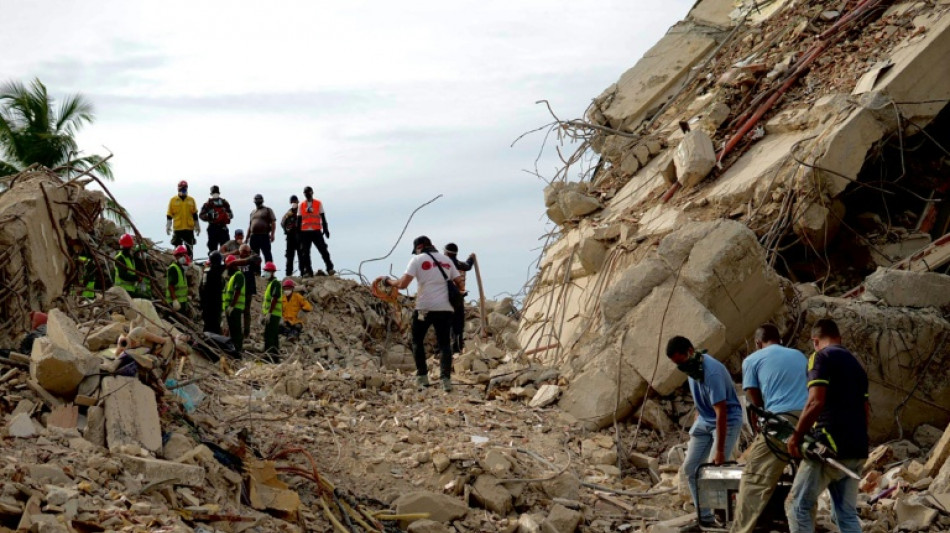
Venezuela quake tragedy threatens to set back democratic transition / Photo: © AFP/File

 London
 24 °C
24 °C

 Manchester
 18 °C
18 °C
 Glasgow
16 °C
Glasgow
16 °C
 Dublin
 24 °C
24 °C
 Belfast
23 °C
Belfast
23 °C
 Washington
23 °C
Washington
23 °C
 Denver
 15 °C
15 °C
 Atlanta
28 °C
Atlanta
28 °C
 Dallas
29 °C
Dallas
29 °C
 Houston Texas
31 °C
Houston Texas
31 °C
 New Orleans
30 °C
New Orleans
30 °C
 El Paso
22 °C
El Paso
22 °C
 Phoenix
29 °C
Phoenix
29 °C
 Los Angeles
20 °C
San Diego
21 °C
San Francisco
14 °C
Chicago
Los Angeles
20 °C
San Diego
21 °C
San Francisco
14 °C
Chicago
 16 °C
Minneapolis
11 °C
Seattle
12 °C
Portland
14 °C
Salt Lake City
16 °C
Las Vegas
25 °C
Miami
30 °C
Jacksonville
28 °C
San Antonio
28 °C
Bermuda
30 °C
Nassau
18 °C
Iqaluit
3 °C
Yellowknife
14 °C
Anchorage
16 °C
Minneapolis
11 °C
Seattle
12 °C
Portland
14 °C
Salt Lake City
16 °C
Las Vegas
25 °C
Miami
30 °C
Jacksonville
28 °C
San Antonio
28 °C
Bermuda
30 °C
Nassau
18 °C
Iqaluit
3 °C
Yellowknife
14 °C
Anchorage
 9 °C
Fairbanks
6 °C
Barrow
9 °C
Fairbanks
6 °C
Barrow
 -2 °C
Calgary
13 °C
Edmonton
26 °C
Winnipeg
13 °C
Goose Bay
11 °C
Halifax
15 °C
Boston
17 °C
Ottawa
12 °C
Toronto
13 °C
Detroit
15 °C
Cleveland
16 °C
New York
19 °C
Baltimore
22 °C
Philadelphia
20 °C
Nuuk (Godthåb)
4 °C
Hong Kong
-2 °C
Calgary
13 °C
Edmonton
26 °C
Winnipeg
13 °C
Goose Bay
11 °C
Halifax
15 °C
Boston
17 °C
Ottawa
12 °C
Toronto
13 °C
Detroit
15 °C
Cleveland
16 °C
New York
19 °C
Baltimore
22 °C
Philadelphia
20 °C
Nuuk (Godthåb)
4 °C
Hong Kong
 28 °C
Singapore
28 °C
Melbourne
29 °C
Canberra
8 °C
Adelaide
28 °C
Singapore
28 °C
Melbourne
29 °C
Canberra
8 °C
Adelaide
 10 °C
Darwin
25 °C
Perth
15 °C
Fort Worth
29 °C
Honolulu
25 °C
Sydney
15 °C
Johannesburg
23 °C
Dubai
36 °C
Mumbai
26 °C
Zürich
21 °C
Tokyo
24 °C
Seoul
19 °C
Delhi
30 °C
Beijing
19 °C
Riyadh
37 °C
Prague
16 °C
Pennsylvania
19 °C
Valletta
29 °C
Manama
34 °C
Warsaw
13 °C
Stockholm
15 °C
10 °C
Darwin
25 °C
Perth
15 °C
Fort Worth
29 °C
Honolulu
25 °C
Sydney
15 °C
Johannesburg
23 °C
Dubai
36 °C
Mumbai
26 °C
Zürich
21 °C
Tokyo
24 °C
Seoul
19 °C
Delhi
30 °C
Beijing
19 °C
Riyadh
37 °C
Prague
16 °C
Pennsylvania
19 °C
Valletta
29 °C
Manama
34 °C
Warsaw
13 °C
Stockholm
15 °C
Venezuela's devastating earthquake threatens to set back momentum for a democratic transition, with the United States under President Donald Trump even more set on prioritizing stability over elections.
Just a week before the powerful double-earthquake, which has killed more than 3,800 people, the US spearheaded a long-awaited step toward power-sharing, with an opposition figure meeting in Caracas with the National Assembly chief who is the brother of interim President Delcy Rodriguez.
That June 18 meeting now feels like long ago, and Trump has appeared peeved that the most visible opposition leader, Nobel Peace Prize winner Maria Corina Machado, had hoped to return to Venezuela in the disaster's aftermath.
The Caracas talks were meant to herald the second stage of what US Secretary of State Marco Rubio has called a three-part strategy -- stabilization followed by recovery and then transition. Venezuela, it appears, is now back on the stabilization phase.
The US is "100 percent focused on this response to the devastating earthquakes in Venezuela and in advancing the Trump administration's three-phase plan for Venezuela, which remains intact," said John Barrett, the top US diplomat in Caracas.
Trump ordered a deadly raid in Caracas on January 3 that snatched president Nicolas Maduro, a firebrand leftist and US nemesis. Rodriguez, who was Maduro's vice president, quickly took over with the support of Trump, who has threatened her with violence if she does not cooperate on his key priorities, starting with working with US oil companies.
"Trump is taking advantage of the situation so American companies can win contracts and gain access to resources" in the country with the world's largest oil reserves, a former Venezuelan senior official said.
The US has sent in quake rescue teams boosting the humanitarian response as Venezuelans have jeered the efforts of Rodriguez's government.
One US official blamed the poor Venezuelan response on Maduro, whose "regime pillaged the country for decades." Rodriguez and other interim authorities, the US official told AFP, "have been fully cooperative" with the US.
David Smilde, an expert on Venezuela at Tulane University, said that Trump primarily cares about Venezuela's oil and other natural resources and forcing it to take back migrants.
"Trump doesn't really care about democracy," Smilde said, while adding that others in the administration such as Rubio had more nuanced takes.
"There is a real danger that the Trump administration just works perpetually with Delcy Rodriguez or whoever can provide stability."
- Machado plots return -
The US for years had imposed stringent sanctions on Venezuela and, along with many Latin American and European countries, championed the opposition, which many observers say won a fraudulent 2024 vote in which Maduro gained another term.
But after ousting Maduro, Trump marginalized opposition chief Machado, even though she physically handing him her Nobel Peace Prize.
Machado has insisted she will return.
"I am absolutely convinced that my presence would help advance the transition process. And even more since the June 24 tragedy, my presence would bring stability," she told a group of international journalists including AFP.
"This tragedy is further evidence of what we all know, which is that Venezuela has become a failed state," she said.
Juan Manuel Trak, a Venezuelan professor and analyst based in Mexico, said that for Washington, Machado's return "puts at risk the stabilization phase and raises the risk of political instability."
"Machado could, in a way, serve as a catalyst for discontent," Trak said.
- Remaking region -
Rodriguez has attacked Machado for seeking to return, saying, "I don't understand how in this moment of sadness and national mourning... some dare plot social unrest. Here, we will not have a social unrest."
Trump's embrace of Rodriguez has stunned some members of his Republican Party, especially in southern Florida, Rubio's political base and a bastion of opposition to Latin America's leftists, notably in Cuba.
Florida Senator Rick Scott said that Rodriguez remained an illegitimate ruler and that the US should ensure that no aid is channeled through her.
"She sits at the top of a brutal criminal regime responsible for years of repression, corruption and suffering. A natural disaster does not change that," the Republican lawmaker said in a statement to AFP.
But for the Trump administration, a country that had been a thorn in the side of Washington for three decades is suddenly cooperating.
"There's no doubt in my mind that Delcy Rodriguez is attempting to use this tragedy in order to further the status quo," said Geoff Ramsey, a senior analyst at intelligence firm Recorded Future.
He said the US is working so closely with Rodriguez because it "has an opportunity to bring Venezuela under its geopolitical influence in a way that seemed unthinkable just six months ago."
P. Duarte--JDB