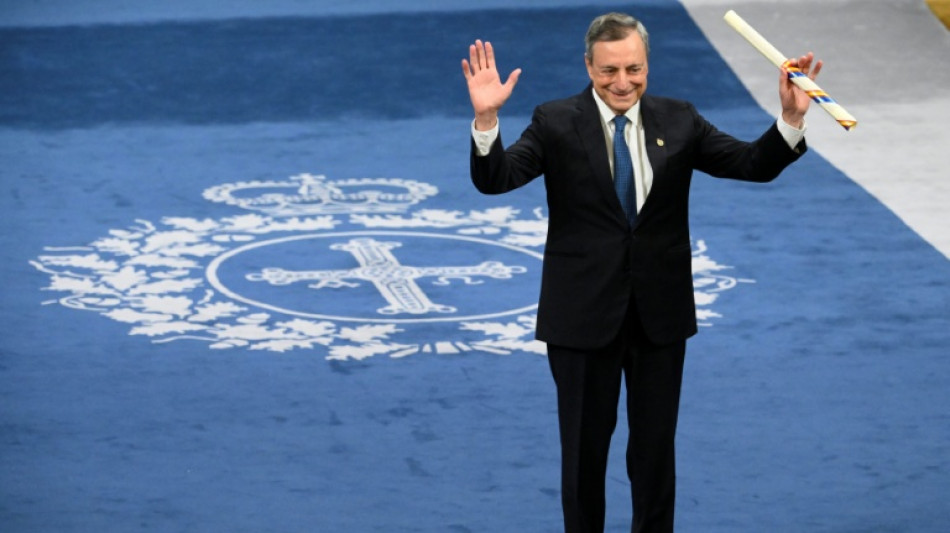
Former ECB chief Mario Dragi wins Charlemagne Prize / Photo: © AFP/File

 London
 18 °C
18 °C
 Manchester
10 °C
Manchester
10 °C
 Glasgow
 12 °C
12 °C
 Dublin
14 °C
Dublin
14 °C
 Belfast
12 °C
Belfast
12 °C
 Washington
28 °C
Washington
28 °C
 Denver
 34 °C
34 °C
 Atlanta
28 °C
Atlanta
28 °C
 Dallas
 35 °C
35 °C
 Houston Texas
34 °C
Houston Texas
34 °C
 New Orleans
32 °C
New Orleans
32 °C
 El Paso
34 °C
El Paso
34 °C
 Phoenix
 46 °C
46 °C
 Los Angeles
31 °C
San Diego
28 °C
San Francisco
20 °C
Chicago
22 °C
Minneapolis
28 °C
Seattle
22 °C
Portland
23 °C
Salt Lake City
39 °C
Las Vegas
46 °C
Miami
Los Angeles
31 °C
San Diego
28 °C
San Francisco
20 °C
Chicago
22 °C
Minneapolis
28 °C
Seattle
22 °C
Portland
23 °C
Salt Lake City
39 °C
Las Vegas
46 °C
Miami
 24 °C
Jacksonville
27 °C
San Antonio
32 °C
Bermuda
27 °C
Nassau
25 °C
Iqaluit
13 °C
Yellowknife
21 °C
Anchorage
21 °C
Fairbanks
25 °C
Barrow
10 °C
Calgary
33 °C
Edmonton
26 °C
Winnipeg
29 °C
Goose Bay
25 °C
Halifax
25 °C
Boston
26 °C
Ottawa
25 °C
Toronto
25 °C
Detroit
25 °C
Cleveland
24 °C
New York
26 °C
Baltimore
27 °C
Philadelphia
27 °C
Nuuk (Godthåb)
8 °C
Hong Kong
24 °C
Jacksonville
27 °C
San Antonio
32 °C
Bermuda
27 °C
Nassau
25 °C
Iqaluit
13 °C
Yellowknife
21 °C
Anchorage
21 °C
Fairbanks
25 °C
Barrow
10 °C
Calgary
33 °C
Edmonton
26 °C
Winnipeg
29 °C
Goose Bay
25 °C
Halifax
25 °C
Boston
26 °C
Ottawa
25 °C
Toronto
25 °C
Detroit
25 °C
Cleveland
24 °C
New York
26 °C
Baltimore
27 °C
Philadelphia
27 °C
Nuuk (Godthåb)
8 °C
Hong Kong
 25 °C
Singapore
29 °C
Melbourne
27 °C
Canberra
8 °C
Adelaide
12 °C
Darwin
25 °C
Perth
9 °C
Fort Worth
36 °C
Honolulu
27 °C
Sydney
14 °C
Johannesburg
6 °C
Dubai
33 °C
Mumbai
28 °C
Zürich
20 °C
Tokyo
33 °C
Seoul
30 °C
Delhi
32 °C
Beijing
31 °C
Riyadh
25 °C
Singapore
29 °C
Melbourne
27 °C
Canberra
8 °C
Adelaide
12 °C
Darwin
25 °C
Perth
9 °C
Fort Worth
36 °C
Honolulu
27 °C
Sydney
14 °C
Johannesburg
6 °C
Dubai
33 °C
Mumbai
28 °C
Zürich
20 °C
Tokyo
33 °C
Seoul
30 °C
Delhi
32 °C
Beijing
31 °C
Riyadh
 34 °C
Prague
17 °C
Pennsylvania
27 °C
Valletta
29 °C
Manama
33 °C
Warsaw
19 °C
Stockholm
14 °C
34 °C
Prague
17 °C
Pennsylvania
27 °C
Valletta
29 °C
Manama
33 °C
Warsaw
19 °C
Stockholm
14 °C
Former European Central Bank chief Mario Draghi has won the annual Charlemagne prize for promoting European unity, organisers said Saturday, as they warned that Europe needs to urgently boost its economy.
"The situation is serious," German MP and prize-committee head Armin Laschet said."Europe must not become a pawn of external powers in the face of overlapping geopolitical crises."
Laschet added, in a sombre opening speech: "If Europe is not competitive economically it will not, in the long-term, have the financial basis, the technological basis, the industrial basis to guarantee its security."
Draghi -- who was widely credited with saving the euro from collapse after promising in 2012 to do "whatever it takes" to shore up the currency amid a eurozone debt crisis -- has since urged Europe to deepen economic integration to better compete with the United States and China.
Draghi, a former Italian prime minister, delivered 383 recommendations in his landmark 2024 EU competitiveness report, urging common regulation of capital markets and less red tape for business overall.
Europe is under increasing pressure to boost its economy, as anti-establishment parties score election wins across the continent and Russia and the United States have turned increasingly hostile.
"This decision comes at a time when Europe has perhaps never had as many enemies as it does now, both internal and external," Draghi said in a short acceptance speech transmitted by video.
"We have to become stronger, stronger militarily, stronger economically and stronger politically," he added.
Named after the Frankish ruler Charlemagne, the first to unify much of western Europe after the fall of the western Roman Empire, the prize is awarded by a 17-strong committee mostly made up of people linked to Aachen, Charlemagne's capital.
Previous winners of the prize include Pope Francis, Ukranian leader Volodymr Zelensky along with the Ukranian people, as well as French president Emmanuel Macron and former Czech president and anti-communist dissident Vaclav Havel.
L.M. Cardoso--JDB