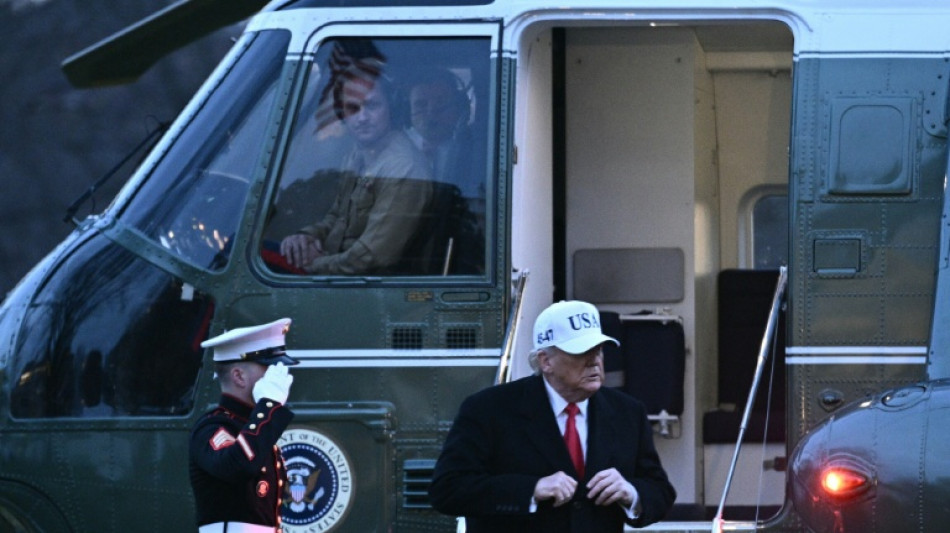
One year in, Trump shattering global order / Photo: © AFP

 London
 16 °C
16 °C

 Manchester
10 °C
Manchester
10 °C
 Glasgow
 11 °C
11 °C
 Dublin
14 °C
Dublin
14 °C
 Belfast
11 °C
Belfast
11 °C
 Washington
27 °C
Washington
27 °C
 Denver
 30 °C
30 °C
 Atlanta
27 °C
Atlanta
27 °C
 Dallas
32 °C
Dallas
32 °C
 Houston Texas
33 °C
Houston Texas
33 °C
 New Orleans
 30 °C
30 °C
 El Paso
33 °C
El Paso
33 °C
 Phoenix
 44 °C
44 °C
 Los Angeles
28 °C
San Diego
25 °C
San Francisco
19 °C
Chicago
21 °C
Minneapolis
25 °C
Seattle
19 °C
Portland
Los Angeles
28 °C
San Diego
25 °C
San Francisco
19 °C
Chicago
21 °C
Minneapolis
25 °C
Seattle
19 °C
Portland
 22 °C
Salt Lake City
35 °C
Las Vegas
44 °C
Miami
26 °C
Jacksonville
26 °C
San Antonio
30 °C
Bermuda
26 °C
Nassau
24 °C
Iqaluit
12 °C
Yellowknife
21 °C
Anchorage
21 °C
Fairbanks
26 °C
Barrow
9 °C
Calgary
29 °C
Edmonton
22 °C
Winnipeg
23 °C
Goose Bay
22 °C
Halifax
23 °C
Boston
25 °C
Ottawa
22 °C
Toronto
24 °C
Detroit
22 °C
Salt Lake City
35 °C
Las Vegas
44 °C
Miami
26 °C
Jacksonville
26 °C
San Antonio
30 °C
Bermuda
26 °C
Nassau
24 °C
Iqaluit
12 °C
Yellowknife
21 °C
Anchorage
21 °C
Fairbanks
26 °C
Barrow
9 °C
Calgary
29 °C
Edmonton
22 °C
Winnipeg
23 °C
Goose Bay
22 °C
Halifax
23 °C
Boston
25 °C
Ottawa
22 °C
Toronto
24 °C
Detroit
 23 °C
Cleveland
23 °C
New York
25 °C
Baltimore
27 °C
Philadelphia
26 °C
Nuuk (Godthåb)
8 °C
Hong Kong
23 °C
Cleveland
23 °C
New York
25 °C
Baltimore
27 °C
Philadelphia
26 °C
Nuuk (Godthåb)
8 °C
Hong Kong
 25 °C
Singapore
30 °C
Melbourne
26 °C
Canberra
13 °C
Adelaide
14 °C
Darwin
29 °C
Perth
13 °C
Fort Worth
32 °C
Honolulu
27 °C
Sydney
17 °C
Johannesburg
6 °C
Dubai
33 °C
Mumbai
28 °C
Zürich
19 °C
Tokyo
35 °C
Seoul
32 °C
Delhi
31 °C
Beijing
34 °C
Riyadh
33 °C
Prague
17 °C
Pennsylvania
26 °C
Valletta
28 °C
Manama
34 °C
Warsaw
18 °C
Stockholm
13 °C
25 °C
Singapore
30 °C
Melbourne
26 °C
Canberra
13 °C
Adelaide
14 °C
Darwin
29 °C
Perth
13 °C
Fort Worth
32 °C
Honolulu
27 °C
Sydney
17 °C
Johannesburg
6 °C
Dubai
33 °C
Mumbai
28 °C
Zürich
19 °C
Tokyo
35 °C
Seoul
32 °C
Delhi
31 °C
Beijing
34 °C
Riyadh
33 °C
Prague
17 °C
Pennsylvania
26 °C
Valletta
28 °C
Manama
34 °C
Warsaw
18 °C
Stockholm
13 °C
One year into his second term, US President Donald Trump is shattering the post-World War II order as never before, leaving a world that may be unrecognizable once he is through.
Far from slowing down, Trump -- who turns 80 in June -- has rung in the new year with a slew of aggressive actions that brazenly defy the decades-old structure that was championed by the United States.
Trump on January 3 ordered an attack on oil-rich Venezuela that left more than 100 people dead in which commandos snatched leftist president Nicolas Maduro, a longtime US nemesis.
Since then, Trump has threatened force against both friend and foe.
The Republican leader has ramped up calls to seize Greenland from NATO ally Denmark and warned of striking Iran as the clerical regime violently represses protests.
He has also mused of military action in both Colombia and Mexico, although has appeared to back down after speaking to their presidents -- a mercurial style his supporters say shows that Trump prefers diplomacy when he can achieve outcomes he likes.
But Trump has also jettisoned traditional ways of statecraft as he vows to go it alone in his "America First" vision, most recently pulling the United States out of dozens more UN bodies and other international groups.
"Many international organizations now serve a globalist project rooted in the discredited fantasy of the 'End of History,'" Secretary of State Marco Rubio said, referring to the post-Cold War hope of a stable world with a consensus for democracy.
Trump's unrepentant embrace of force has also played out at home. Led by Vice President JD Vance, his administration offered not even pro forma sympathy when a masked anti-immigration agent fatally shot a motorist in Minneapolis, instead surging in forces.
Stephen Miller, the architect of Trump's racially charged anti-immigrant campaign who has played a growing role in foreign policy as White House deputy chief of staff, said it was time to move beyond "international niceties."
"We live in a world, in the real world... that is governed by strength, that is governed by force, that is governed by power," Miller said in a CNN interview.
- No higher purpose -
The United States led the creation of post-World War II international institutions from the United Nations to NATO, which Trump has also denounced as unfair to the United States.
US leaders have frequently been accused of hypocrisy, such as in 2003 when George W. Bush invaded Iraq after bypassing the United Nations.
The difference, some observers say, is that Trump rarely even makes the pretense of pursuing higher "universal" principles such as promoting democracy.
In Venezuela, where Rubio and others had long branded Maduro illegitimate after reports of wide election irregularities, Trump has dismissed the opposition and said he wants to work with Maduro's vice president, the new interim leader.
Trump said the priority was to control Venezuela's oil and that he would wield the threat of force to keep the country in line.
French President Emmanuel Macron warned that the current American approach could spell an era of "new colonialism and new imperialism," four years after Russia invaded Ukraine.
"The United States is an established power, but one that is gradually turning away from some of its allies and breaking free from international rules that it was still promoting recently," Macron said.
- Permanent changes -
Melanie Sisson, a fellow at the Brookings Institution, said the United States had long succeeded "without having to attack, conquer and invade."
"We were generally able to get our way, more often than not, using other tools of influence, exercised through international organizations and alliances," she said.
Even if Europe pines for the liberal order, Sisson said other powers are sure to follow Trump's lead in pursuing raw self-interest.
"I don't think there's going to be a reconstruction of the post-World War II international order as we might recognize it," she said.
"That doesn't mean some of the core principles of that order couldn't be reconstituted, but Trump is reshaping international politics in a way that will be durable."
One diplomat from a US ally, who spoke on condition of anonymity to be frank, said even if Trump's methods can be shocking, the time was ripe for change.
Russia and Israel both pursued military campaigns unimpeded by wide international condemnation, he said.
"It was clear that the global order wasn't working, even if we pretended it was."
F. Tavares--JDB