Rout in Seoul stocks leads Asian losses as AI tech rally hits wall / Photo: © AFP

 London
 9 °C
9 °C

 Manchester
 10 °C
10 °C
 Glasgow
12 °C
Glasgow
12 °C
 Dublin
 10 °C
10 °C
 Belfast
10 °C
Belfast
10 °C
 Washington
 15 °C
15 °C
 Denver
21 °C
Denver
21 °C
 Atlanta
16 °C
Atlanta
16 °C
 Dallas
22 °C
Dallas
22 °C
 Houston Texas
25 °C
Houston Texas
25 °C
 New Orleans
23 °C
New Orleans
23 °C
 El Paso
22 °C
El Paso
22 °C
 Phoenix
33 °C
Phoenix
33 °C
 Los Angeles
23 °C
San Diego
22 °C
San Francisco
15 °C
Chicago
19 °C
Minneapolis
16 °C
Seattle
11 °C
Portland
12 °C
Salt Lake City
22 °C
Las Vegas
29 °C
Miami
Los Angeles
23 °C
San Diego
22 °C
San Francisco
15 °C
Chicago
19 °C
Minneapolis
16 °C
Seattle
11 °C
Portland
12 °C
Salt Lake City
22 °C
Las Vegas
29 °C
Miami
 28 °C
Jacksonville
24 °C
San Antonio
23 °C
Bermuda
25 °C
Nassau
16 °C
Iqaluit
-2 °C
Yellowknife
1 °C
Anchorage
8 °C
Fairbanks
-1 °C
Barrow
-1 °C
Calgary
8 °C
Edmonton
18 °C
Winnipeg
14 °C
Goose Bay
8 °C
Halifax
9 °C
Boston
12 °C
Ottawa
6 °C
Toronto
10 °C
Detroit
15 °C
Cleveland
14 °C
New York
16 °C
Baltimore
15 °C
Philadelphia
15 °C
Nuuk (Godthåb)
0 °C
Hong Kong
28 °C
Jacksonville
24 °C
San Antonio
23 °C
Bermuda
25 °C
Nassau
16 °C
Iqaluit
-2 °C
Yellowknife
1 °C
Anchorage
8 °C
Fairbanks
-1 °C
Barrow
-1 °C
Calgary
8 °C
Edmonton
18 °C
Winnipeg
14 °C
Goose Bay
8 °C
Halifax
9 °C
Boston
12 °C
Ottawa
6 °C
Toronto
10 °C
Detroit
15 °C
Cleveland
14 °C
New York
16 °C
Baltimore
15 °C
Philadelphia
15 °C
Nuuk (Godthåb)
0 °C
Hong Kong
 30 °C
Singapore
30 °C
Singapore
 32 °C
Melbourne
29 °C
Canberra
32 °C
Melbourne
29 °C
Canberra
 21 °C
Adelaide
20 °C
Darwin
21 °C
Adelaide
20 °C
Darwin
 33 °C
Perth
21 °C
Fort Worth
23 °C
Honolulu
28 °C
Sydney
29 °C
Johannesburg
17 °C
Dubai
32 °C
Mumbai
32 °C
Zürich
12 °C
Tokyo
25 °C
Seoul
25 °C
Delhi
26 °C
Beijing
24 °C
Riyadh
26 °C
Prague
11 °C
Pennsylvania
11 °C
Valletta
25 °C
Manama
30 °C
Warsaw
10 °C
Stockholm
3 °C
33 °C
Perth
21 °C
Fort Worth
23 °C
Honolulu
28 °C
Sydney
29 °C
Johannesburg
17 °C
Dubai
32 °C
Mumbai
32 °C
Zürich
12 °C
Tokyo
25 °C
Seoul
25 °C
Delhi
26 °C
Beijing
24 °C
Riyadh
26 °C
Prague
11 °C
Pennsylvania
11 °C
Valletta
25 °C
Manama
30 °C
Warsaw
10 °C
Stockholm
3 °C
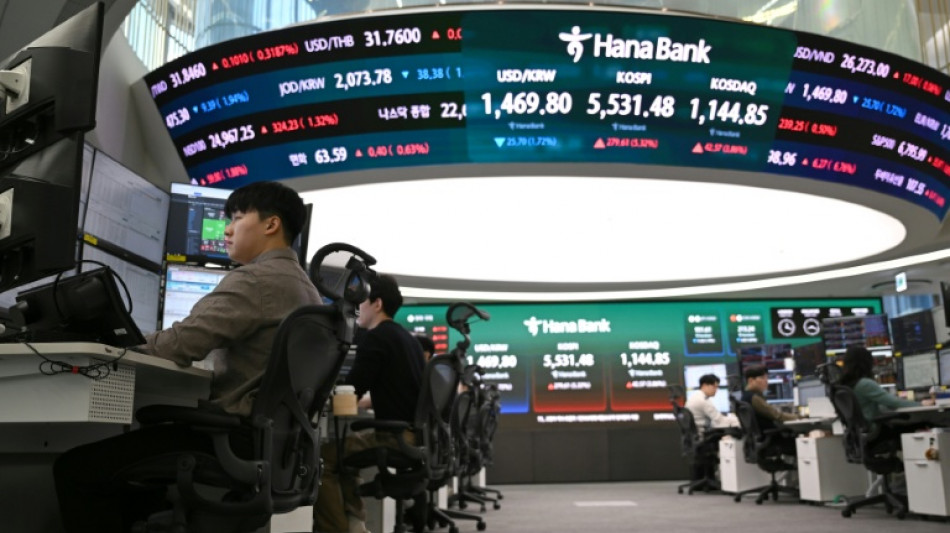
Seoul's Kospi stock index dived more than eight percent to lead a rout across Asia on Monday as tech firms were hammered and strong US jobs data fuelled bets on a Federal Reserve interest rate hike.
News that Iran and Israel had traded fire sparked worries about an escalation of the Middle East crisis, adding to the gloomy mood on trading floors and sending oil prices surging more than three percent.
The technology sector bore the brunt of losses on Monday as investors cashed out following a breathtaking surge in recent months powered by a race into all things linked to artificial intelligence.
The selling came after a closely watched report on Friday showed more than double the amount of US jobs than expected were created in May, while those in the previous two months were revised higher.
Analysts said that showed the world's top economy remained resilient in the face of surging prices, but ramped up bets on the Fed raising interest rates.
Yields on US Treasury bonds rose as investors anticipated higher rates, while the dollar strengthened against its main rivals.
All three main indexes on Wall Street tumbled on Friday, led by a four percent drop in the Nasdaq.
That heavy selling extended into Asia, where tech-rich markets felt the most pain.
Seoul -- which has hit multiple record highs this year -- tanked 8.3 percent as chipmaker Samsung shed more than 10 percent and rival SK hynix lost 7.7 percent.
Taipei and Tokyo each dived more than three percent, while there were also hefty losses in Hong Kong, Shanghai, Singapore, Manila, Mumbai, Jakarta, Wellington and Bangkok.
London, Paris and Frankfurt opened in the red.
- 'Disappointing guidance' -
Bitcoin was hovering around $63,000 after sinking below $60,000 on Friday to its lowest level since October 2024, just before the election of Donald Trump to the US presidency propelled it to a record high.
"Stronger-than-expected labour market data reignited concerns that the Federal Reserve may be preparing to embark on a new tightening cycle," said SPI Asset Management's Stephen Innes.
He added that "fading hopes for progress in Middle East peace negotiations kept energy markets on edge, and a handful of disappointing guidance updates from major technology companies interrupted what had become an increasingly one-way artificial intelligence trade".
Investors were already concerned about extended valuations in the AI realm, which has been the main catalyst for a global market surge in the past two years, eclipsing worries about the Middle East crisis.
US chipmaker Broadcom's below-forecast revenue outlook for the third quarter added to those concerns.
Fears about a re-escalation of the Iran war pushed crude prices sharply higher after Israeli said on Monday it had struck targets in western and central Iran, as Iranian state TV reported explosions in the cities of Tehran, Tabriz and Isfahan.
The attacks came a day after Israel said its military intercepted incoming Iranian missiles, the first such barrage since an April ceasefire took hold.
Tehran called the attack a "warning" after strikes on Beirut's southern suburbs.
Israel's strikes came hours after Trump called on it to refrain from retaliating.
- Key figures at around 0715 GMT -
Seoul - Kospi: DOWN 8.3 percent at 7,484.41 (close)
Tokyo - Nikkei 225: DOWN 3.9 percent at 64,024.60 (close)
Hong Kong - Hang Seng Index: DOWN 1.6 percent at 24,569.10
Shanghai - Composite: DOWN 1.7 percent at 3,959.34 (close)
London - FTSE 100: DOWN 0.3 percent at 10,335.68
West Texas Intermediate: UP 4.5 percent at $94.61 a barrel
Brent North Sea Crude: UP 4.9 percent at $97.63 a barrel
Euro/dollar: DOWN at $1.1516 from $1.1520 on Friday
Pound/dollar: DOWN at $1.3323 from $1.3333
Dollar/yen: UP at 160.28 yen from 160.23 yen
Euro/pound: UP at 86.43 pence from 86.41 pence
New York - DOW: DOWN 1.4 percent at 50,866.78 (close)
M. de Jesus--JDB